About · CommodityHub East Africa

A market information platform for East Africa.

We publish verified daily commodity prices across nine Kenyan markets — built so the farmer in Eldoret, the trader in Wakulima, and the contractor in Kisii each see the same number the institutional analyst sees, at the same time.

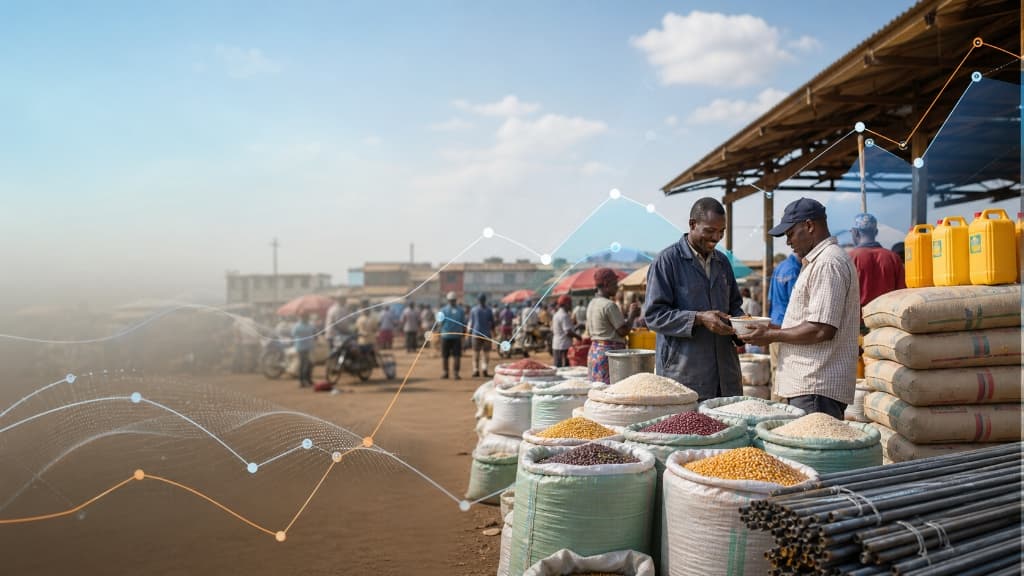
Traders at a Kenyan market with price-trend lines overlaid, illustrating how CommodityHub turns real market activity into legible price data.
Mission

Make commodity markets transparent, efficient, and fair.

Across East Africa, prices vary significantly by location, season, quality, transport cost, storage availability, and demand. Farmers often sell without knowing the best available market price; traders rely on informal networks; builders and consumers lack a simple way to know whether they're paying fair.

CommodityHub East Africa exists to close that gap — by giving every participant the same access to reliable prices, verified counterparties, logistics options, and (in time) structured trading tools.

The problem

East African commodity markets are active, and chronically opaque.

/ 01

Price information lives in private channels.

A farmer in Nakuru does not know the maize price in Eldoret. A builder in Kisii does not know whether cement is cheaper in Nairobi. Information lives in WhatsApp groups, broker phones, and depot ledgers — never in one place.

/ 02

The advantage flows to whoever has the bigger phone book.

Large traders and middlemen aggregate prices across markets. Small farmers and small retailers do not. The result is depressed farm-gate prices and inflated retail margins — a tax on the participants least equipped to absorb it.

/ 03

Quality varies; comparisons mislead.

Maize at 13.5% moisture is not maize at 18%. Cement at 32.5N is not cement at 42.5N. Without standard grades and canonical units, the cheapest quoted price is often the most expensive in practice.

/ 04

Existing data is institutional, not everyday.

RATIN, KNBS, NCPB, and county reports publish authoritative data — but slowly, in PDFs, in formats designed for analysts. Nothing today bundles food and construction commodities into a single mobile-first product for the people who actually trade them.

What we're building

Four phases. Trust before transactions.

We deliberately stay outside the regulated-exchange perimeter until scale, partnerships, and capital justify applying. Until then we are what East Africa needs first: a credible market information platform.

ACTIVE
Phase I · Now

Price Intelligence

Daily prices across 19 active commodities (41 in the regional reference set, monthly cadence) and 9 Kenyan towns. Confidence-scored, source-attributed, and accessible on every channel small traders actually use.

Phase II · Building · Q3 2026

Verified Marketplace

Verified buyers and sellers post offers and requests. Reputation-weighted, peer-to-peer, with the platform acting as introducer only — not as a counterparty.

Phase III · Year 2

Trade Facilitation

Digital purchase orders, escrow via licensed payment partners, quality inspection, warehouse-receipt referrals, and structured dispute resolution.

Phase IV · Year 3+

Regulated Exchange Pathway

Either apply directly for a Capital Markets Authority commodity-exchange licence, or partner with a licensed exchange and provide the front-end discovery layer.

Why now

The rails for structured trade are finally in place.

60%+
Smartphone penetration · Kenya

Above the threshold at which app-first distribution becomes viable for everyday traders.

USD 6–9B
Tradable basket · SAM · Kenya

Cereals, pulses, horticulture, sugar, edible oils, and key building materials, before regional flows.

One
Operational Warehouse Receipt System

Supervised by the WRSC, creating the institutional rails for structured trade and warehouse-receipt finance.

Roadmap · 12 months

What the next four quarters look like.

Months 1–3
Q1
Build & closed beta
  • Incorporate CommodityHub East Africa Limited
  • Hire founding team: lead dev, data lead, ops lead
  • MVP web, Android, admin dashboard
  • Train 4 monitors in Nakuru, 4 standby in Nairobi
  • Closed beta with 200 invited users
  • ODPC registration
Months 4–6
Q2
Public launch in 9 cities
  • Public launch: Nakuru, Nairobi, Eldoret, Kisumu, Mombasa, Kisii, Kitale, Meru, Karatina
  • WhatsApp bot and SMS short code live
  • First 3 dealer / warehouse partnerships signed
  • 10,000 monthly active users
  • Trader tier launched · first 500 paying subscribers
Months 7–9
Q3
Construction & marketplace beta
  • Deepen market penetration across the 9 active counties
  • USSD channel via MNO partnership
  • Construction materials coverage added (cement → iron sheets)
  • Contractor tier launched
  • Marketplace beta: maize, beans, cement
  • First data licensing deal (bank or microfinance)
Months 10–12
Q4
Cross-border & Seed
  • Cross-border pilot: Busia, Malaba, Namanga, Isebania
  • Enterprise tier with API access
  • National launch event in Nairobi
  • 50,000 MAUs · 3,000 paying subscribers
  • Close Seed round to fund Phases 2 & 3
From the founder

Why this, why now, why us.

I grew up watching farmers in Kisii sell maize at prices set by whoever showed up at the gate, while the same bag sold for thirty percent more two towns over. The information was always there, somewhere — in a WhatsApp group, in a depot ledger, on a broker's phone — but it was never on a screen the farmer could open. That gap is the entire reason this platform exists.

CommodityHub East Africa is not a commodity exchange. Not yet. The Capital Markets (Commodity Markets) Regulations are clear about what an exchange is and what capital, licensing, and infrastructure it requires. We will get there — eventually — by earning the scale and the partnerships that justify the application. Until then we are what East Africa actually needs first: a market information platform that is trustworthy on day one, on every channel the user already uses.

The plan is to start small and credible in Nakuru, prove the data quality, expand to nine launch markets, and to do all of that before asking the user for a shilling. Free remains free. Paid tiers exist for the people whose margins move on it.

If any of this resonates — as a user, an early monitor, an institutional data partner, or an investor — write to me at samuel@commodityhub.co.ke.

Samuel Ombongi Anyona
Founder · CommodityHub East Africa · Nakuru, 2026
Regulatory positioning

Outside the exchange perimeter — by design, for now.

The Capital Markets Act and the Capital Markets (Commodity Markets) Regulations define a commodity exchange as one licensed by the Capital Markets Authority for spot commodity trading, including clearing, settlement, or transfer services.

CommodityHub East Africa is not licensed under those regulations and does not hold itself out as a commodity exchange. Phase 1 (price intelligence) and Phase 2 (verified marketplace) operate as a market information and digital marketplace platform. Phase 2 transactions are peer-to-peer; we act as introducer and information provider, not counterparty.

Phase 3 trade-facilitation services will be delivered through licensed third parties — a payment service provider, an inspection company, and a recognised dispute-resolution forum — so the platform does not need an exchange or clearing licence to operate them.

When Phase 4 (regulated exchange) becomes appropriate — based on scale, capital, and regulator feedback — we will either apply directly for a commodity exchange licence under the Capital Markets (Commodity Markets) Regulations, or partner with an existing licensed exchange while providing the front-end information, marketplace, and discovery layer.

We are registered with the Office of the Data Protection Commissioner under the Data Protection Act, 2019. For specific legal queries: legal@commodityhub.co.ke.

Press & partnerships

We publish monthly market commentary, licensed free to national publications in exchange for attribution.

press@commodityhub.co.ke →